
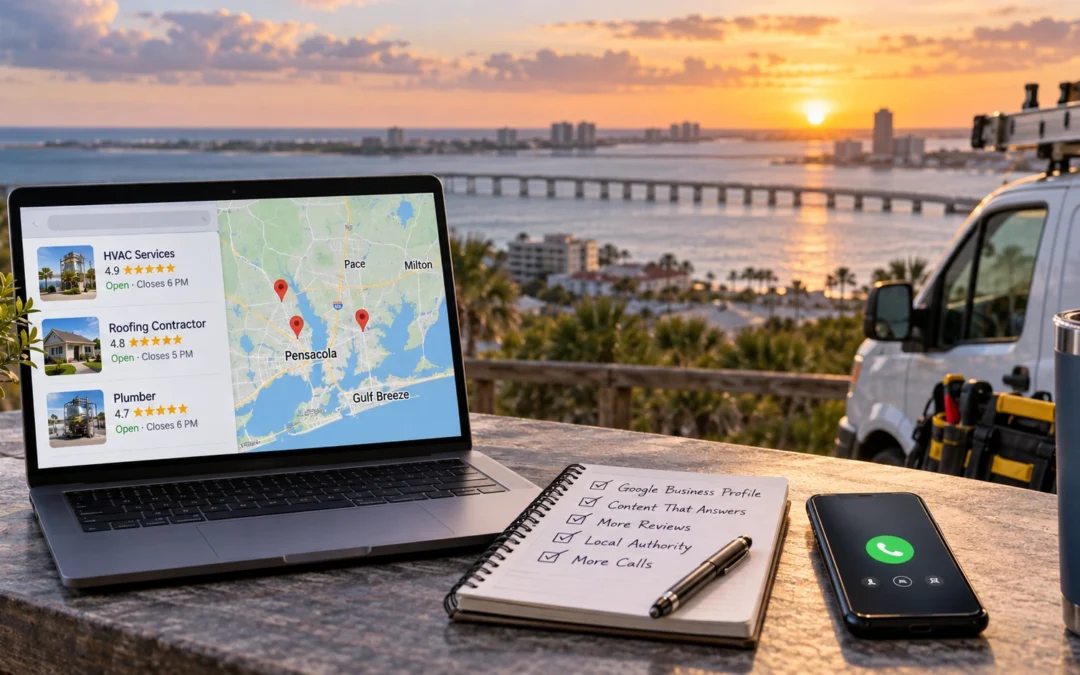
Local SEO that converts doesn't put your name in results and call it done. It positions your business as the specific, credible answer that AI-driven search surfaces when a buyer is ready to hire someone. For service businesses across Pensacola and the surrounding region, the gap between visibility and booked calls runs through your Google Business Profile, your content structure, and the reputation signals that AI systems pull from when constructing answers.
Key Takeaways
- Rankings without conversion signals are a vanity metric. What matters is whether AI systems surface your business when a buyer asks a real service question.
- An incomplete or unmanaged Google Business Profile is one of the fastest ways to lose qualified leads to a competitor in your own market.
- A thin review profile creates buyer hesitation at the exact moment a competitor with a stronger one doesn't have to.
- Structuring content to answer specific buyer questions is a distinct discipline from traditional keyword optimization, and it's what tends to earn AI citations.
- Month-to-month engagements mean the work has to keep producing booked calls. That accountability changes how campaigns get built.
Why Is Your Search Presence Not Producing More Calls?
You're showing up in search. You might even be ranking for several terms. But the call volume doesn't reflect it.
Here's the mechanism behind that disconnect.
When a buyer types a service question into Google, an AI-generated summary can answer that question directly and name specific businesses in the process. Consider a plausible scenario: two businesses cited in that summary rank lower in the organic results than a third competitor that doesn't appear in the summary at all. That third business, despite its higher organic position, could get overlooked entirely because the cited businesses captured the buyer's attention before they ever scrolled to the organic listings.
That scenario illustrates a structural shift in how search works. It didn't arrive as one dramatic update. It built gradually through AI summaries, zero-click results, and featured snippets that answer the buyer's question before they need to click anything. A business still optimizing purely for keyword positions is tuning a system that no longer reflects how buyers actually make contact. The 2026 state of search engine optimization in Pensacola covers that shift in detail, including what's changed and what still works.
What Does Local SEO Actually Mean for a Service Business?
Local SEO is the practice of becoming the most credible, specific answer for service-related searches in a defined geographic area.
That's different from "ranking for local keywords." Ranking is a byproduct. Authority is the goal.
For service businesses across Pensacola, Pace, Gulf Breeze, Milton, and the broader Escambia, Santa Rosa, Okaloosa, Baldwin, and Mobile counties, three systems have to work together.
Your Google Business Profile has to be fully built out, actively managed, and structured around the questions buyers ask before hiring. Category selection, service descriptions, photo recency, and review velocity all feed the algorithm deciding whether you appear in the local pack or get pushed below a competitor who did the ongoing work you skipped.
Your website has to give AI systems something worth citing. That means clear, direct answers to the questions buyers type before they make a call. Not keyword-stuffed service pages. Not generic "we serve the Pensacola area" language. Specific, structured answers that a language model can extract without guessing at your relevance. Getting your site ready for AI-driven search is a distinct discipline from traditional on-page SEO, and it reaches outcomes that traditional optimization can't reliably produce on its own anymore.
Your reputation has to close the loop. A buyer who finds you in search will check your reviews before they call. A weak review profile creates hesitation at exactly the moment your competitor's strong one doesn't, and that hesitation typically resolves in your competitor's favor.
Why Do Most Local SEO Campaigns Fall Short?
The root cause usually isn't budget. It isn't even execution.
It's the wrong success metric.
When the goal is "rank for these ten terms," every decision optimizes toward that. Content gets written for keyword density. Links get built to shift a position. The Google Business Profile gets configured once and left alone. The whole system gets tuned to produce a cleaner dashboard, not more booked calls.
Consider a typical situation in competitive home services: a roofing company ranks for a solid list of service terms, the dashboard looks respectable, and yet the phone volume stays flat. Nothing in that system was built to convert a searcher into a caller. The rankings are real. The calls aren't there. That's what optimizing for the wrong metric tends to produce.
The businesses that appear in AI citations have typically structured their content, their profiles, and their reputation to answer buyer questions directly and credibly. If you want to understand how answer engine optimization fits alongside traditional SEO for local lead generation, that's worth reviewing before making any campaign decisions.
How Do You Build Local SEO That Actually Produces Calls?
The process isn't complicated. It is genuinely different from what most agencies are still selling.
Start with what you already have. Many established service businesses carry more existing authority than they're using. Rankings, citations, indexed content, and review history are already in place. The question is whether they're structured to convert. An honest audit finds what's producing calls and what's quietly leaking leads.
Fix the Google Business Profile first. This is typically the highest-leverage starting point for service businesses. Properly optimizing your Google Business Profile affects local pack placement, AI summary citations, and review visibility at the same time. A profile built once and never touched again tends to stall as competitors who manage theirs actively pull ahead.
Structure your website to answer real buyer questions. Every service page should directly address the specific question a buyer would type before hiring someone in your category. Not a generic service description. A direct answer to the question behind the search. That specificity is what AI systems tend to extract when building summaries. Vague, broad service descriptions don't give them much to work with. Understanding what AEO is and how it works is a practical starting point if this approach is new to you.
Build a review engine, not just a review count. Reputation marketing treats your review profile as a conversion asset rather than a side project. A strong, recent, high-volume review profile tends to resolve buyer hesitation before the phone ever rings because reviews answer the unspoken objection a buyer carries. That's different from occasionally asking a satisfied customer to leave a rating. The reputation marketing approach treats reviews as a live, ongoing signal that feeds both AI citation systems and buyer confidence simultaneously.
Expand authority in the specific markets you actually serve. If you serve Gulf Breeze, Milton, Escambia County, and Baldwin County, your SEO has to reflect those specific communities. Geo-specific content and citation signals are what tend to earn citations in specific local markets. Generic regional positioning doesn't give AI systems enough geographic specificity to work with.
What Do the Real Tradeoffs Look Like?
Approach |
What It Optimizes For |
What It Misses |
Likely Outcome |
|---|---|---|---|
Keyword ranking campaigns only |
Position in organic results |
AI citations, zero-click results, conversion signals |
Cleaner dashboard, flat call volume |
GBP setup with no ongoing management |
Initial local pack placement |
Review velocity, profile freshness, competitive movement |
Some early results, ceiling hit quickly |
Content-only SEO with no local signals |
Organic traffic volume |
Local pack visibility, review authority, geo-specific citations |
Better suited to national brands than local service businesses |
Waiting or going it alone |
Short-term cost avoidance |
Every system that produces booked calls |
Leads flow toward competitors who acted while your position erodes |
Full local authority build with Yolee Solutions |
AI citations, review signals, geo-specific content, active GBP management |
Addressed through consistent execution |
Conversion-driven results tied to calls, not dashboard metrics |
The comparison that matters isn't which approach costs less today. It's what it costs when the wrong approach runs for twelve months while competitors build the kind of authority that takes time and consistent execution to catch.
Done halfway, local SEO burns time and produces nothing measurable.
Who Is This Built For?
Yolee Solutions works with established service businesses typically doing $500K to $10M annually. That includes home services, legal, medical, IT, and professional services businesses that are already operating, already have some search presence, and need that presence to produce better-quality inbound leads rather than better-looking reports.
The month-to-month engagement structure exists because the work has to keep producing results. That's a meaningful structural difference from long-term contracts where the incentive to perform can disappear once you've signed.
It's worth being honest about where this approach works best. The compounding effect that makes authority-building efficient depends on having existing signals to build on. A business with some ranking history, some reviews, and an existing website can move faster than one starting from nothing. That's not a weakness in the approach. It's an accurate description of where it delivers the most.
The founder brings 28 years as a retired Naval Commander and a decade as a senior IT specialist and consultant to senior management. That background, combined with extensive training in website development, search engine optimization, and reputation marketing, produces an approach grounded in measurable outcomes rather than activity reports.
The businesses that shouldn't wait on this decision are the ones watching a competitor's review count climb while theirs stays flat, or ranking for terms that produce zero calls. That gap doesn't hold steady. Every month of inaction is a month of leads going to whoever did act.
Frequently Asked Questions
How long does local SEO take to produce calls?
Google Business Profile improvements and review velocity changes can produce visible movement faster than broader authority-building work. Geo-specific citations and content restructuring take longer to affect AI citations and organic placement. The timeline depends heavily on how competitive your service category is in your specific market. Any agency offering a guaranteed timeline is optimizing for the sale, not the outcome.
Is Google Business Profile optimization really different from regular SEO?
Yes, and the difference matters specifically for local service businesses. GBP optimization affects placement in the local map pack and in AI-generated results, which operate on different signals from organic rankings. A business can rank well organically and still be invisible in the local pack if the profile is incomplete or left unmanaged. Both systems feed different parts of the buyer's decision, and both need to work.
What is answer engine optimization, and why does it matter for local businesses?
Answer engine optimization (AEO) is the practice of structuring your content so that AI systems, not just traditional search algorithms, surface your business when a buyer asks a service question. The relationship between AEO and traditional SEO is complementary, not competitive. Understanding how AEO works is a practical first step for any service business that wants to build more durable visibility than keyword position alone can provide.
What makes Yolee Solutions different from other local SEO agencies in the region?
The focus is on conversion signals, not ranking signals. Every optimization decision gets evaluated against one question: does this produce more booked calls? The work is grounded in 28 years of military leadership, a decade as a senior IT specialist and consultant, and extensive training in website development, SEO, and reputation marketing. That combination produces an approach oriented toward measurable outcomes rather than activity reports.
What role do reviews play in local SEO?
Reviews function as a ranking signal, a conversion signal, and an AI citation signal at the same time. A business with a strong, recent, high-volume review profile is more likely to appear in local pack results, more likely to be cited in AI summaries, and more likely to convert a searcher into a caller when they do appear. A weak review profile doesn't just create hesitation. It makes the competitor with a stronger one look like the obvious choice.
What's the biggest mistake service businesses make with local SEO?
Treating it as a one-time setup rather than an ongoing conversion system. A Google Business Profile built once and never updated, a review profile that stopped growing after the first few months, and service pages written for keyword density rather than buyer questions are the three most common failure points. Each one individually reduces call volume. All three together means your visibility is working harder for your competitors than it is for you.
Can I realistically handle local SEO on my own?
You can manage the basics. The businesses that consistently earn AI citations and local pack placement are doing considerably more than the basics. The technical structure required for AI content extraction, ongoing review management, and geo-specific citation building all require consistent execution over time. The question isn't whether you're capable of learning it. It's what you lose while you're figuring it out, and whether your competitors are giving you that time. If you want an honest read on whether paying someone to handle SEO is worth it, that's a good place to start.
If your business is visible in search but the phone isn't reflecting it, that's a conversion problem with a specific fix. Contact Yolee Solutions to schedule a consultation and find out exactly where your current setup is losing calls.
