
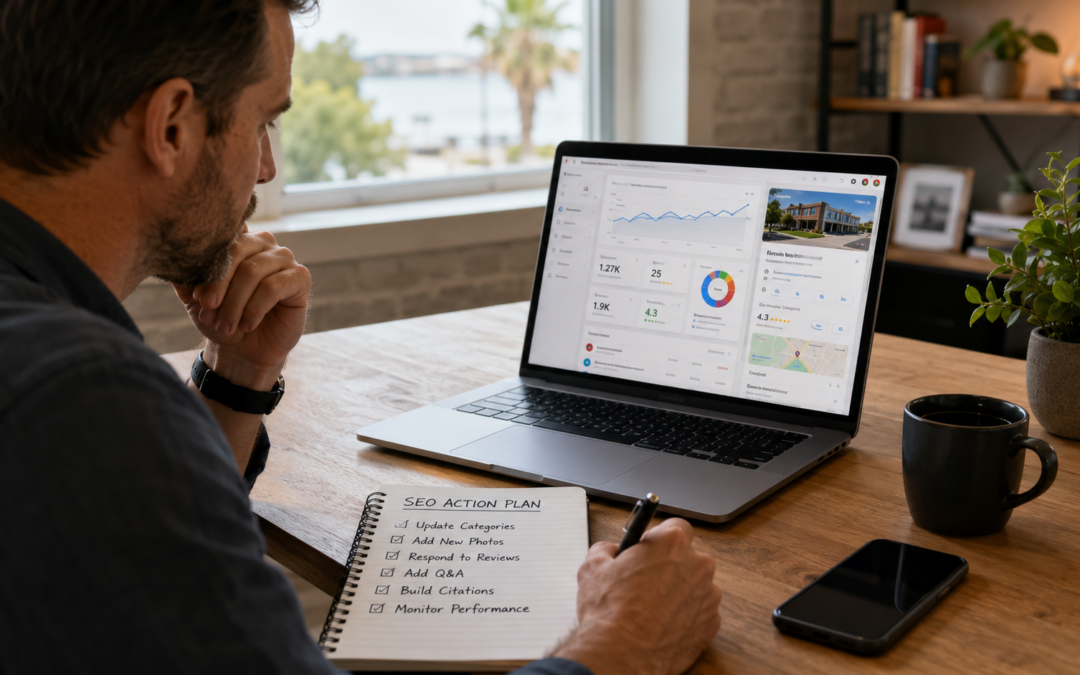
Your Google Business Profile has been sitting in the same state for six months. Rankings haven’t moved. Calls are flat. And you’re genuinely unsure whether the problem is that you haven’t done enough, or that you’ve been doing the wrong things at the wrong time.
Timing in local SEO isn’t about patience. It’s about reading the right signals and knowing which ones actually predict results.
Direct Answer
The right time to act on Google My Business optimization is when your profile shows verifiable gaps: incomplete categories, missing service areas, no recent reviews, or photos older than 90 days. Waiting is only justified when a recent change needs time to index. In every other case, delay compounds the problem because competitors fill the authority gap your profile leaves open.
Key Takeaways
- Incomplete Google Business Profiles don’t hold position; they lose it to competitors who are actively optimizing
- Acting on the wrong signals (minor ranking fluctuations, seasonal dips) wastes resources; acting on structural gaps produces results
- The Signal-Action Matrix gives you a repeatable way to decide what to fix now versus what to monitor
- Google My Business optimization is a prerequisite for AI-driven search visibility, not a separate task
- Waiting for “the right moment” is the most expensive timing decision a local business can make
Why Does Google My Business Optimization Timing Feel So Confusing?
Most service business owners treat their Google Business Profile like a set-it-and-forget-it directory listing. That assumption is the problem.
Google’s local search algorithm treats your profile as a live signal. It reads how recently you updated photos, how consistently you respond to reviews, whether your service categories match what searchers are actually asking for. A profile that hasn’t changed in six months isn’t neutral. It’s actively deprioritized in favor of profiles that show recent engagement.
The confusion about timing comes from a category error: owners watch ranking positions instead of watching profile health signals. Rankings fluctuate for dozens of reasons, many of which have nothing to do with your profile. Profile health signals are within your control and directly connected to whether Google surfaces you in the local pack and, increasingly, in AI-generated summaries.
The signal that matters isn’t your ranking position. It’s the completeness and recency of the information Google has to work with.
This is why Google Business Profile optimization has to be treated as ongoing maintenance, not a one-time setup task. For small businesses in Pensacola that rely on local search, the gap between a maintained profile and a neglected one closes faster than most owners expect.
What Is the Signal-Action Matrix and How Do You Use It?
The Signal-Action Matrix is a decision tool for separating profile signals that require immediate action from signals that only require monitoring.
Here’s how it works. Every signal your profile generates falls into one of two categories: structural gaps or performance noise.
Structural gaps are conditions that directly limit how Google can represent your business. Missing primary category, no service area defined, fewer than 10 reviews with no responses, photos older than 90 days, inconsistent NAP (name, address, phone) data across listings. These are act-now signals. Waiting on any of them means you’re handing authority to whoever acts first.
Performance noise is everything else: a three-day ranking dip after a Google update, a slight drop in profile views during a holiday week, a competitor temporarily outranking you on a single keyword. These are monitor signals. Acting on them with major profile changes can actually destabilize what’s working.
Signal Type |
Examples |
Correct Response |
Timeline |
Structural gap |
Missing category, no reviews, outdated photos |
Act immediately |
Within 48 hours |
Authority gap |
Fewer citations than top competitor, no Q&A section |
Act within the week |
3-7 days |
Performance noise |
Weekly ranking fluctuation, seasonal view drop |
Monitor only |
30-day window |
Algorithm shift |
Core update affecting local pack positions |
Audit first, then act |
2-4 weeks post-update |
Reputation signal |
New negative review, unanswered reviews |
Act immediately |
Within 24 hours |
Use this when you’re deciding whether a change in your profile metrics justifies action. Don’t use it to rationalize inaction on structural gaps.
Isn’t Waiting the Safe Move When You’re Not Sure?
No. And this is the claim most business owners get exactly backwards.
Waiting feels cautious. It feels like you’re avoiding mistakes. But in local SEO, your profile doesn’t sit still while you think. Your competitors are optimizing. Google’s algorithm is re-evaluating authority signals constantly. Every week your profile stays incomplete is a week that gap widens.
A common scenario: a service business in Pensacola has a Google Business Profile with a correct address and phone number but no secondary categories, no service descriptions, and 14 reviews from two years ago with no responses. A competitor opens nearby, builds their profile correctly from day one, and starts collecting reviews with consistent responses. Within 90 days, the competitor is appearing in the local pack for searches the established business used to own. Not because they did anything extraordinary. Because they acted and the established business waited.
The cost of waiting isn’t visible until it’s already happened. If you’ve ever wondered why your business isn’t ranking on Google in Pensacola, this pattern of unaddressed structural gaps is almost always part of the answer.
This is the same dynamic that makes AEO and traditional SEO diverge so sharply right now. AI-driven search surfaces businesses with the most complete, consistent, and recently validated authority signals. A profile that hasn’t been touched in months doesn’t get the benefit of the doubt from an AI summary. It gets skipped.
What Signals Actually Predict a Profile Is Ready to Convert?
This is the follow-up question most owners don’t think to ask. Getting into the local pack is one problem. Converting that visibility into booked calls is a different problem entirely.
Profile signals that predict conversion (not just visibility) include:
- Reviews that mention specific services, not just general praise
- A complete Q&A section that answers the questions searchers actually ask before calling
- Photos that show the work, the team, or the location, not just a logo
- A business description that states what you do, who you serve, and where you serve them in plain language
- Response patterns that show the business is active and responsive
These aren’t cosmetic details. They’re the signals that tell a prospective customer whether calling you is worth the risk. Testimonials and reviews resolve hesitation at the moment of decision because they answer the objection the buyer hasn’t voiced yet.
Yolee Solutions approaches local SEO services with this conversion layer as the primary objective, not just profile completeness for its own sake. Visibility without conversion is a vanity metric.
If you’re unsure where your profile stands right now, Yolee Solutions offers a free SEO score review that shows exactly which signals are working and which are costing you calls.
How Does Google My Business Optimization Connect to AI Search?
This is where the timing conversation gets more urgent.
Google’s AI Mode and AI Overviews pull from structured, verified, consistent business data. When someone asks an AI assistant “who’s the best HVAC company near Pensacola,” the answer doesn’t come from whoever ranks first on a keyword. It comes from whoever has the most coherent, complete, and trusted authority profile across their Google Business Profile, their website, and their citation network.
Schema markup and entity-based SEO are the technical layer that connects your Google Business Profile signals to your website’s authority. A profile that’s optimized in isolation, without that connection to your broader web presence, captures less of the AI-driven search opportunity than one that’s part of a coordinated authority strategy.
This is why the timing question isn’t just about when to update your profile. It’s about when to build the full structure that makes your business citable by AI systems, not just findable by traditional search.
The businesses that prepare their web presence for AI search now are the ones that will own local AI citations when their competitors finally realize what changed.
Who Should Not Wait Another Quarter on This?
This approach matters most when any of the following are true for your business:
- You’re in a service category with active local competition (HVAC, roofing, legal, medical, home services)
- Your profile has structural gaps identified in the Signal-Action Matrix above
- You’ve received negative reviews in the last 90 days without a response
- Your primary competitors have more reviews, more recent photos, and more complete service descriptions than you do
- You’re not appearing in AI-generated local summaries for your core service terms
If none of those apply, you’re in a monitoring position, not an action position. But be honest about the assessment. Most established service businesses that think they’re in good shape have at least two structural gaps they haven’t noticed.
The businesses this doesn’t serve well are those with no web presence at all, no existing Google Business Profile, or no defined service area. Those situations require foundational setup work before optimization timing becomes relevant. Yolee Solutions is direct about this: optimization accelerates what’s already there. It doesn’t substitute for the foundation. If you’re weighing whether the investment makes sense, understanding what SEO actually costs for Pensacola businesses can help you frame that decision clearly.
The One Thing That Changes How You Read Every SEO Timing Decision
Waiting for certainty before acting on your Google Business Profile is the most expensive timing decision in local SEO, because the cost doesn’t show up until the authority gap is already too wide to close quickly.
That’s the reframe. You’re not choosing between acting now and acting later. You’re choosing between acting now and paying more later for the same result, or not getting the result at all.
Yolee Solutions works with established service businesses in Pensacola and nationally to identify exactly where that gap is and close it before it compounds. The 30-minute authority review is the fastest way to get a clear picture of what’s working, what’s not, and what to act on first.
Schedule your authority review with Yolee Solutions and find out which signals are costing you calls right now.
Frequently Asked Questions
How long does it take to see results from Google My Business optimization?
Profile changes like category updates, new photos, and review responses can affect local pack visibility within two to four weeks. Structural improvements like citation consistency and service description updates typically show measurable impact in 60 to 90 days. There are no guarantees on timeline, but structural gaps that go unfixed don’t improve on their own.
Does my Google Business Profile affect how AI search tools describe my business?
Yes, directly. AI systems like Google’s AI Overviews and AI Mode pull from your Google Business Profile as a primary data source when generating local business summaries. An incomplete or outdated profile produces incomplete or absent AI citations, regardless of how well your website ranks.
What’s the difference between a ranking drop and a real problem with my profile?
A ranking drop is a symptom. A profile problem is a cause. If your ranking drops but your profile is complete, recently updated, and actively collecting reviews, the drop is likely performance noise from an algorithm update or competitor activity. If your profile has structural gaps, the drop is a signal that those gaps are being penalized.
Should I be optimizing my Google Business Profile even if I already rank well locally?
Ranking well today doesn’t protect you from losing position tomorrow. Google’s local algorithm re-evaluates authority signals continuously. A profile that isn’t actively maintained loses ground to competitors who are optimizing, especially as AI-driven search increases the weight given to profile completeness and recency.
Can I do Google Business Profile optimization myself or do I need a professional?
Basic updates like adding photos and responding to reviews can be done without professional help. The strategic layer, including category selection, service area configuration, citation network alignment, and connection to your website’s entity signals, produces significantly better results with professional guidance. The gap between a self-managed profile and a professionally optimized one is where most of the conversion difference lives.
How does reputation management connect to Google Business Profile timing?
Your review profile is one of the highest-weight signals in local search authority. A negative review that goes unanswered is an active drag on both your ranking and your conversion rate. Reputation management isn’t separate from Google My Business optimization. It’s one of the most time-sensitive components of it.
What makes Yolee Solutions different from other SEO companies in Pensacola?
Yolee Solutions focuses on authority positioning in AI-driven search rather than traditional ranking metrics. The objective is always booked calls and qualified leads, not visibility scores. Their approach connects Google Business Profile optimization to your broader web presence and citation structure so that AI systems can accurately represent your business, not just search algorithms.
About the Author
Yolee Solutions is a Pensacola-based SEO consultancy specializing in Google My Business optimization, local SEO strategy, reputation management, and Answer Engine Optimization for the AI-driven search era. They work with established service businesses operating locally and nationally to convert existing search visibility into qualified leads and booked calls, without relying on vanity metrics or outdated ranking frameworks.
