
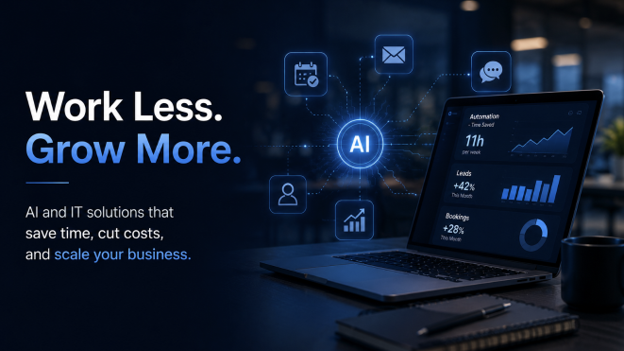
According to McKinsey & Company, businesses that adopt AI-driven automation in their operations report measurable productivity gains within the first year. Yet most small business owners are still running on the same IT infrastructure they had five years ago. That gap is not a technology problem. It is a decision problem
Small business IT solutions refer to the combination of cloud systems, automation tools, and AI-assisted workflows that allow service businesses to operate with fewer manual bottlenecks, lower overhead, and faster response times. Implemented correctly, they reduce the time staff spend on repetitive tasks, improve lead response rates, and create the kind of consistent client experience that drives referrals. Without requiring a full in-house IT department.
Key Takeaways
- AI automation handles the repetitive work that drains your team’s time, scheduling, follow-ups, intake forms, so your people focus on billable work
- IT system optimization is not about buying new software; it is about eliminating the friction between the tools you already own
- Zero-click and AI-driven search results now favor businesses with structured, authoritative digital presence. Your IT setup directly affects your search visibility
- The businesses winning in 2026 are not the ones with the most technology; they are the ones with the least unnecessary complexity
- A phased implementation approach, not a full overhaul, produces the most durable efficiency gains for established service businesses
Why Are Small Businesses Still Losing Hours to Tasks AI Can Handle Today?
The problem is not awareness. Most business owners have heard about AI. They have seen the demos. They have read the headlines.
The real problem is that most small businesses have accumulated a stack of disconnected tools. A CRM that does not talk to their scheduling software, a phone system that does not log to their email, a Google Business Profile that nobody updates. Every tool works. Nothing connects.
The inefficiency is not in any single system. It is in the gaps between them.
A HVAC company in the Southeast was spending roughly 11 hours per week on manual appointment confirmations, follow-up calls, and rescheduling. Not because they lacked a booking system. They had one. The system just was not connected to their customer communication workflow. One integration, not one new tool, recovered those hours.
That is the pattern. The solution is almost never “buy something new.” It is “connect what you have, automate what repeats, and stop paying people to do what software does faster.”
What Does AI Actually Do for a Service Business. Practically?
AI for small businesses is not a robot replacing your staff. It is the elimination of the manual layer between a customer action and a business response.
Here is what that looks like in practice:
- Automated lead intake: A prospect fills out a contact form at 9 PM. An AI-triggered sequence sends a confirmation, qualifies the inquiry with two questions, and books a call. Before your competitor’s team opens in the morning
- Reputation monitoring: AI tools scan review platforms and flag negative mentions within hours, not days, giving you a response window that protects your local search authority
- Content and FAQ generation: AI drafts answers to common customer questions in your voice, which then feed structured FAQ schema on your website. Directly improving your visibility in AI-driven search summaries
- Scheduling and dispatch: For field service businesses, AI-assisted scheduling reduces drive time and increases daily job capacity without adding headcount
Practitioners report that service businesses implementing even two of these automations see meaningful reductions in administrative labor within 60 to 90 days. The mechanism is straightforward: you are removing the human decision point from tasks that have no decision variance. Every confirmation email is the same. Every intake form asks the same questions. AI does not make those better. It just does them without forgetting.
The businesses winning in 2026 are not the ones with the most technology. They are the ones with the least unnecessary complexity.
How Do You Actually Optimize IT Systems Without a Full Overhaul?
This is where most guides lose the plot. They recommend enterprise-level audits for businesses running on five-person teams.
The IT Efficiency Stack Review is a simpler framework. It works like this: map every recurring task that touches a digital tool, identify which tasks require human judgment and which do not, then automate the ones that do not. That is the entire methodology.
The IT Efficiency Stack Review is defined as a structured three-step audit, map, classify, automate, that identifies which operational tasks can be systematically removed from human workflow without affecting quality or client experience.
Use it when: your team is doing the same task more than three times per week and the outcome is always the same.
Do not use it when: the task involves client relationship judgment, escalation decisions, or anything where a wrong automated response creates a trust problem.
In practical terms, this looks like:
Task Type |
Human Required? |
Automation Candidate |
Appointment confirmation |
No |
Yes. High priority |
New client intake form |
Partially |
Yes. With routing logic |
Negative review response |
Yes |
No. Flag only |
Invoice generation |
No |
Yes. Immediate ROI |
Proposal writing |
Yes |
Partially. AI draft, human edit |
Follow-up after estimate |
No |
Yes. Sequence automation |
Complex complaint handling |
Yes |
No |
The table above is not theoretical. It reflects the operational pattern Yolee Solutions observes when working with established service businesses on their digital infrastructure. The tasks that drain hours are almost always the ones with the most predictable outcomes.
Does Better IT Actually Affect Search Visibility? (Most Business Owners Don’t Know It Does)
Here is the contrarian claim: your IT setup is an SEO asset, and most businesses are treating it like overhead.
Structured data, page load speed, mobile responsiveness, FAQ schema markup. These are IT decisions that directly determine whether Google’s AI summaries cite your business or your competitor’s. Search has changed. AI-driven search now pulls answers from structured, technically clean sources. A slow, unstructured website with no schema markup does not rank poorly in 2026. It simply does not get cited at all.
Visibility without structure is invisible. AI search engines do not reward effort. They reward extractable answers.
Yolee Solutions works with service businesses specifically on this intersection. Where IT optimization meets search authority. The approach is not about chasing algorithm updates. It is about building the kind of digital infrastructure that AI systems trust: fast-loading pages, structured FAQ content, consistent NAP data across directories, and a Google Business Profile that signals active, authoritative operation.
A regional plumbing company that had ranked on page one for years saw their inbound call volume drop by roughly a third after AI summaries began dominating local search results. Their rankings had not changed. The search landscape had. After implementing structured FAQ schema, updating their Google Business Profile with service-specific content, and improving mobile load time, their call volume recovered within four months. No new ads. No new rankings. Just a digital presence that AI search could actually read and cite.
What Are the Real Tradeoffs Between DIY AI Tools and Managed IT Support?
Not every business needs an agency. Let us be honest about that.
Approach |
Best For |
Tradeoffs |
DIY tools (Zapier, Make, ChatGPT) |
Solopreneurs, very early stage |
Time-intensive setup, no strategic oversight |
Managed IT provider |
Businesses with compliance needs, multi-location |
Higher cost, often not search-aware |
SEO + IT strategy firm (like Yolee Solutions) |
Established service businesses wanting lead growth |
Requires business readiness, not a quick fix |
In-house hire |
Businesses with 15+ staff, complex infrastructure |
High fixed cost, hard to find generalists |
The honest answer is that DIY tools work. Until they do not. The failure point is usually integration: tools that worked independently break when connected, and the business owner who set them up is now the only person who understands how they work.
Who Is This Approach Not Right For?
This guide assumes you are an established service business with existing operations, some digital presence, and a real volume of recurring tasks worth automating.
If you are pre-revenue or in your first year of operation, the priority is not efficiency. It is finding what works. Automating a broken process makes a broken process faster.
If your primary challenge is generating any leads at all (not converting them), the IT and AI efficiency layer is not your constraint. Lead generation strategy comes first.
And if your business model changes frequently, new services, new markets, new offers every quarter, automated workflows create rigidity that slows you down rather than freeing you up.
Yolee Solutions is direct about this in their free 30-minute authority review: if the fundamentals are not in place, they say so. Efficiency tools on a weak foundation produce efficient failure.
Frequently Asked Questions About Small Business IT Solutions
How much does it actually cost to set up AI automation for a small service business?
Entry-level automation tools like Zapier or Make start under $50 per month for most small businesses. More integrated solutions. Including CRM connections, AI-assisted intake, and structured data implementation. Typically range from a few hundred to a few thousand dollars depending on complexity. The ROI calculation should always start with how many staff hours per week the automation replaces.
How long before I see real results from IT system changes?
Operational changes like automated follow-ups and scheduling integrations typically show measurable time savings within 30 to 60 days. Search visibility improvements from structured data and technical optimization usually take 90 to 180 days to reflect in AI-driven search results. Both timelines assume the changes are implemented correctly the first time.
Will AI tools replace my staff?
No. And businesses that frame it that way tend to implement it poorly. AI automation handles the tasks that have no decision variance: confirmations, reminders, intake routing, invoice generation. The work that requires judgment, relationship, and trust remains human. The goal is to remove the administrative layer so your people spend more time on the work that actually requires them.
What is the single most important IT change a service business can make right now?
Connect your lead intake to your CRM and your CRM to your follow-up sequence. Most businesses are losing leads not because they do not get inquiries, but because response time is too slow. An automated intake-to-response workflow is the highest-ROI single change most service businesses can make in 2026.
Does my Google Business Profile really matter that much for AI search?
Yes. More than most business owners realize. Google’s AI summaries for local service queries pull heavily from Google Business Profile data: services listed, Q&A content, review recency, and photo activity. An inactive or incomplete profile is functionally invisible in AI-driven local search results, regardless of your website rankings.
I already have a website and some SEO. Why am I not getting more calls?
Because rankings and citations are different things now. A page can rank on page one and still not appear in AI summaries if it lacks structured data, clear service descriptions, and FAQ schema. Yolee Solutions specifically addresses this gap. Converting existing visibility into the kind of structured authority that AI search engines surface when a buyer is ready to call.
How do I know if my current IT setup is holding back my search performance?
Run a basic technical audit: check your page load speed on mobile (Google PageSpeed Insights is free), verify your NAP data is consistent across directories, and check whether your site has any structured schema markup. If any of those three are broken, your search performance is constrained regardless of your content quality. Yolee Solutions offers a free SEO score review that covers exactly these factors,
Download the Business Efficiency Checklist. And Stop Guessing What to Fix First
You have just read the framework. Now you need the sequence.
The Business Efficiency Checklist walks you through the exact order of operations: which IT fixes to make first, which automation tools connect without breaking, and which search visibility changes produce the fastest results for service businesses.
Download the checklist today. And bring it to your next team meeting with a specific answer to the question every service business owner eventually asks: where is the work actually getting stuck?
If you want a second set of eyes on your current setup, Yolee Solutions offers a free 30-minute authority review. No pitch. No pressure. Just a 10,000-foot look at where your digital presence is working and where it is costing you calls. For established service businesses wondering whether paying someone to do SEO is worth it, that conversation is a good place to start.
[Get your free SEO score and book your authority review at yoleesolutions.com]
References
McKinsey & Company. Research on AI adoption and productivity outcomes in small and mid-size businesses
Google. PageSpeed Insights tool and Google Business Profile documentation for local search optimization
Gartner. Research on small business technology adoption patterns and IT infrastructure complexity
