
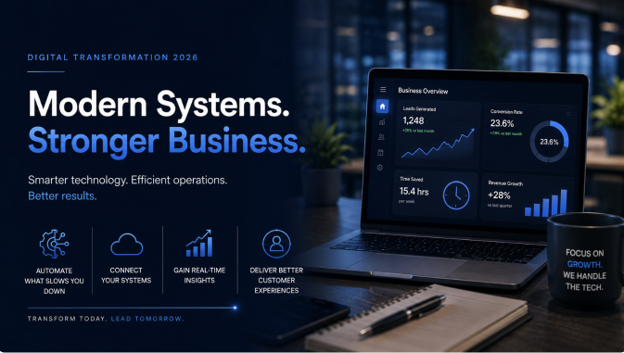
Most established businesses aren’t failing because they lack ambition. They’re failing because they’re running 2015 operations inside a 2026 market. And the gap is widening faster than most owners realize.
Digital transformation solutions are the systems, processes, and technology upgrades that allow an established business to operate more efficiently, serve customers faster, and compete in a search and sales environment increasingly controlled by AI. Done right, transformation isn’t a technology project. It’s a revenue strategy. Done wrong, it’s expensive software no one uses.
Key Takeaways
- Digital transformation is not about buying new tools. It’s about removing the operational friction that quietly kills lead conversion
- AI-driven search has changed how customers find and choose service businesses; visibility without authority positioning no longer converts
- Most transformation projects fail not because of bad technology, but because businesses skip the diagnostic phase
- The businesses winning in 2026 are those that have made themselves easy to find, easy to trust, and easy to book. In that order
- Realistic transformation timelines run 6-18 months for meaningful results; anyone promising faster outcomes at scale is selling something
Why Do So Many Digital Transformation Projects Fail Before They Start?
The answer isn’t budget. It isn’t even technology.
It’s that most businesses start by shopping for solutions before they’ve diagnosed the actual problem. A service company buys a CRM because a competitor has one. A regional contractor invests in a new website because the old one “looks dated.” Neither decision connects to a measurable business outcome.
The root cause of most failed transformation efforts is solution-first thinking. Buying tools to feel modern rather than to solve a specific operational constraint.
McKinsey research on large-scale transformation programs consistently finds that the majority fail to meet their stated objectives, with misalignment between technology investment and business process as the leading cause. The same pattern holds at the small and mid-market level. Just with smaller budgets and less runway to recover.
The diagnostic question every business should ask first: Where exactly does a potential customer fall out of your pipeline? Not “how do we get more traffic”. That’s a symptom question. The real question is structural.
What Does Digital Transformation Actually Mean for a Service Business?
Digital transformation is the process of replacing manual, disconnected, or outdated business operations with integrated systems that reduce friction, improve speed, and generate better data for decisions.
That definition matters because it removes the mythology. Transformation is not about becoming a tech company. It’s not about AI for its own sake. For a plumbing company in Pensacola or a regional HVAC contractor operating across three states, transformation looks like: automated appointment booking that reduces no-shows by 30%, a Google Business Profile that surfaces in AI-generated local results, and a review system that builds trust before the first call is made.
The businesses that win in 2026 aren’t the ones with the most technology. They’re the ones that made themselves easiest to trust at the exact moment a customer is deciding.
Those are not glamorous upgrades. They are, however, the ones that compound.
What Technology Upgrades Actually Move the Needle?
Not all upgrades are equal. Here’s a practical comparison of where transformation investment tends to pay off. And where it tends to disappear:
Upgrade Area |
High-Impact Scenarios |
Lower-Impact Scenarios |
Google Business Profile optimization |
Local service businesses, multi-location companies |
Pure e-commerce with no local presence |
CRM + automated follow-up |
Businesses losing leads in the 24-48hr follow-up window |
Teams already following up same-day consistently |
AI-driven search positioning |
Any business relying on organic search for inbound leads |
Businesses running paid-only acquisition |
Reputation management systems |
Companies with inconsistent or low review volume |
Businesses with 500+ recent reviews and 4.7+ ratings |
Booking and scheduling automation |
Service businesses with phone-heavy intake |
B2B with complex sales cycles requiring human qualification |
The pattern: high-impact upgrades solve a specific, measurable friction point. Low-impact upgrades solve a vague feeling of being behind.
A regional pest control company operating across the Florida Panhandle ran their intake process entirely through inbound phone calls. Average response time: four hours. After implementing automated web booking with SMS confirmation, their no-show rate dropped and conversion from inquiry to booked appointment improved measurably within 90 days. Not because the technology was sophisticated, but because it removed the single biggest drop-off point in their pipeline.
How Has AI Changed the Search Environment. And Why Does That Matter for Transformation?
Here’s the contrarian claim: ranking on Google is no longer the goal. Being chosen by Google’s AI is.
This is not a subtle distinction. When a potential customer searches “best HVAC company near me” in 2026, they are increasingly seeing an AI-generated summary at the top of the results. Not a list of ten blue links. That summary pulls from businesses Google has determined are authoritative, trusted, and well-documented across the web.
If your business isn’t structured to be cited by AI search systems, your rankings are becoming decorative.
Zero-click results. Searches that are answered directly on the results page without the user visiting any website. Now represent a significant share of all search activity, according to research tracked by Sparktoro. For service businesses, this means the traditional “get to page one” strategy is insufficient. The new standard is being the answer, not just appearing near the answer.
This is where digital transformation intersects directly with search strategy. Businesses that have cleaned up their Google Business Profile, built consistent review volume, and structured their website content to answer specific questions are the ones being surfaced in AI summaries. It’s not magic. It’s information architecture. Understanding what answer engine optimization actually involves is increasingly essential for any service business that relies on inbound search for new leads.
At Yolee Solutions, this is the work. Helping established businesses position themselves as the trusted answer in AI-driven search, not just a ranked result.
You didn’t lose rankings. Search changed. The businesses that understand that distinction are the ones still getting calls.
What Does the AI Implementation Process Actually Look Like?
The Visibility-to-Authority Stack is a three-phase framework for understanding where a business sits in the digital transformation process. And what to prioritize next.
Phase 1. Foundation: Business information is accurate, consistent, and complete across all directories and platforms. Google Business Profile is fully optimized. The website answers the questions customers actually ask. This phase is unglamorous and often skipped. It is also the prerequisite for everything else.
Phase 2. Authority Signals: Review volume is growing consistently. The business is being cited in local publications, industry directories, or partner sites. Content on the website demonstrates specific expertise. Not generic “we’re the best” copy, but answers to real questions that establish credibility. This is the phase where AI search systems begin to recognize the business as a reliable source.
Phase 3. Conversion Infrastructure: Booking systems, follow-up automation, and lead capture are working together so that visibility actually converts to calls. A business can rank, appear in AI summaries, and still lose the customer if the next step, booking, creates friction.
Use this framework when: you’re deciding where to invest next. Not when: you’re looking for a shortcut to skip Phase 1.
How Long Does Digital Transformation Actually Take?
Honest answer: longer than most vendors will tell you.
For a service business starting from a weak digital foundation, inconsistent listings, few reviews, no content strategy, meaningful results from a structured transformation effort typically emerge in 6 to 12 months. Full authority positioning in AI-driven search, where the business is being regularly surfaced in AI summaries and featured snippets, generally takes 12 to 18 months of consistent execution.
That timeline is not a failure. It’s the mechanism. Search authority is built through accumulated trust signals. And trust, by definition, cannot be manufactured overnight.
Businesses that have already invested in some foundation work. A functional website, an active Google Business Profile, some review volume. Can see meaningful improvements in lead quality in 90 to 120 days when the strategy is correctly targeted. For local service businesses specifically, investing in local SEO is worth it precisely because the compounding nature of authority signals means earlier action produces disproportionately better returns.
Yolee Solutions works specifically with established businesses that already have some visibility and are asking why that visibility isn’t converting. The diagnostic work, identifying exactly where the pipeline breaks, is where the leverage is.
Who Is This NOT For?
Digital transformation strategy is the wrong investment if:
- Your business has no existing digital presence and needs basic setup first. The foundation has to exist before it can be optimized
- You’re looking for results in 30 days. Transformation is a structural change, not a campaign
- Your primary customer acquisition channel is referral-only and you have no interest in inbound leads
- You’re in a pre-revenue or early-stage business. The strategies here are designed for established operations with existing customer bases
This approach also doesn’t replace the need for a functional sales process. Getting a qualified lead to call is one problem. Converting that call is a different one. Yolee Solutions addresses the first; the second requires internal sales discipline.
Frequently Asked Questions
How do I know if my business actually needs digital transformation, or if I just need better marketing?
If your marketing is generating visibility but not booked calls, the problem is usually structural. Something in the pipeline between “found you” and “called you” is creating friction. That’s a transformation problem, not a marketing spend problem. Better marketing on top of a broken pipeline just accelerates the leak.
What’s the difference between local SEO and AI-driven search optimization?
Local SEO is the practice of making your business visible in geographically relevant searches. Google Maps, local pack results, “near me” queries. AI-driven search optimization is about being selected as the trusted answer in AI-generated summaries, which pull from authority signals across your entire digital presence. In 2026, you need both. But most businesses only have the first.
Is Google My Business still worth investing in?
Yes, and more so than ever. Google’s AI systems use Business Profile data as a primary input for local AI summaries. A fully optimized, actively managed profile. With consistent reviews, accurate information, and regular posts. Is one of the highest-leverage investments a local service business can make right now.
How much should a service business budget for digital transformation?
It depends entirely on where the business starts. Businesses with a functional foundation can see meaningful results with a focused monthly investment in the low four-figure range. Businesses starting from scratch should expect to invest more and wait longer. The diagnostic step, understanding where you actually are, should come before any budget commitment.
What happens to my current SEO rankings during a transformation process?
In most cases, a well-executed transformation improves rankings over time rather than disrupting them. The risk comes from poorly executed technical changes, site migrations, URL structure changes, or content removal, done without proper planning. Yolee Solutions conducts an authority review before making any structural recommendations precisely to avoid this.
Can a small local business compete with national chains in AI-driven search?
Often, yes. And this is one of the genuine advantages of AI-driven search for local businesses. AI summaries frequently favor businesses with strong local authority signals. Consistent reviews, local citations, and community-specific content. Over national brands with generic presence. Local specificity is a competitive asset, not a liability.
How do I get started without committing to a long-term contract before I know if this will work?
Start with a diagnostic. Yolee Solutions offers a free SEO score review and a 30-minute authority review specifically designed to show you where your current digital presence stands and where the highest-leverage opportunities are. Before any commitment. That conversation should tell you whether transformation is the right next step and what it would realistically involve.
Take the Next Step
You’ve just read the framework. You understand the problem. The question now is: where exactly does your business sit in that Visibility-to-Authority Stack. And what’s the specific friction point costing you calls?
Schedule a free business technology audit with Yolee Solutions. In 30 minutes, you’ll know exactly what your current digital presence is doing, what it isn’t, and what one or two changes would have the most direct impact on inbound leads. No pitch deck. No generic recommendations. Just a clear-eyed look at your actual situation.
[Schedule your free audit at yoleesolutions.com]
References
McKinsey & Company. Research on digital transformation program success rates and organizational alignment factors
Sparktoro. Ongoing research on zero-click search behavior and search result engagement patterns
